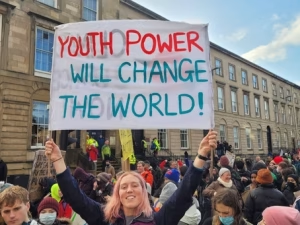

Policy for Future Generations: UKYCC’s vision for future generations
At UKYCC, we dare to imagine a different future, for generations now and to come, and which stands with all species. By repositioning how we define success – beyond GDP as the country’s dominant metric – we can forge a fair and prosperous future for all.
Giving youth a voice in our future report
In March 2026, the UK Youth Climate Coalition joined a group of MPs and civil society groups to advance plans for a Parliamentary Committee for the Future. We believe such a Committee has the potential to safeguard the rights and needs of current and future generations and embed intergenerational thinking into decision-making.
And it’s not just us who think this – we surveyed young people across our networks to bring their voices into the conversation. The Giving Youth a Voice in Our Future report provides a snapshot of the survey results, expanding on presentations to MPs in March.
“None of the issues we face have a 5-year limit. Reacting without considering future consequences is how we got into our current crisis, and considering future generations in government decision-making is how we get out of it”. – Olivia, 27, Edinburgh North & Leith
The message from young people was clear – they are fearful for our future, and angry about inheriting a range of crises that could have been mitigated, or avoided entirely, through long-term planning that puts the needs of people and planet first. There is also hope: through seriously grappling with long-term thinking, we can unlock opportunity, have sustainable social progress, and become a more resilient society – now and in the future.
You can read the full report here.
So, what do we hope to see in the future UK
Climate justice is not a fringe concern but the foundation of all policymaking, and policy is intergenerational by design. Every decision by government, businesses, and community leaders is assessed not only for its short-term gains, but for its long-term impact on people, planet, and prosperity across generations too.
The rights and needs of future citizens are represented in Parliament by a formalised Future Generations Commissioner.
Long-term wellbeing metrics sit alongside GDP, ensuring that we measure what truly matters: health, equity, access to nature, community cohesion, and the resilience of our ecosystems.
Nature is no longer viewed as a resource to be extracted, but a partner in our shared wellbeing. The UK’s landscapes – the moorlands, waters, coastlines, forests, and urban green spaces – are actively restored, rewilded, and protected. Rivers run clean, biodiversity thrives, and communities are deeply involved in stewarding their local environment. Nature-based solutions, like peatland restoration and urban green spaces creation, are mainstream tools across mitigation and adaptation.
People are no longer viewed primarily as economic units, but as citizens with potential, creativity, and inherent dignity. Work exists, but it is meaningful, secure, and balanced. Policies focus on reducing inequality, ensuring universal access to education, healthcare, and housing, and fostering social connection. Community wealth-building, social enterprise, and circular economy principles thrive at the local level.
The transition to a low-carbon society has been fair, with those who contributed least to the climate crisis supported the most. Energy systems are democratic and decentralised, with renewable power owned by communities. Transport is clean, accessible, and affordable. Cities and towns are walkable and bike-friendly, supporting physical and mental health.
If you have ideas on how our future could or should look like, and how to get there, get in touch with us at policyadvocacy@ukycc.org – let’s build a campaign together!
Read our article about the actions taken by Wales, Japan, Ecuador and others, which consider future generations in their national decision-making.
Policy Engagement for Future Generations
Submission to inquiry on building support for energy transition
On 19 February 2025, the Energy Security and Net Zero Committee opened an inquiry to assess whether the Government is communicating effectively to the public, on the objectives and benefits of the transition to net zero.
UKYCC submitted our response, highlighting that young people are not properly informed, engaged with, or equipped to understand and participate in the Government’s progression towards net zero and the energy transition. Read our full response.
UKYCC Autumn Budget Responses
Over the last few year’s, UKYCC have submitted a response to the Autumn Budget, sharing our views on the ost pressing fiscal issues that ought to be considered in preparing the Budget.
You can read more on our views here: